-
Technology
-
Industry
-
Solutions
-
- ASSET MANAGEMENT
- CUSTOMER EXPERIENCE MANAGEMENT
- CYBER SECURITY
- DATA CENTER
- DOCUMENT MANAGEMENT
- ELECTRONIC DATA INTERCHANGE
- ENTERPRISE DATA MANAGEMENT
- ENTERPRISE RESOURCE PLANNING
- ENTERPRISE RISK MANAGEMENT
- ENTERPRISE-GRADE WEB DATA SOLUTIONS
- FACILITY MANAGEMENT
- FIELD SERVICE
- IDENTITY AND ACCESS MANAGEMENT
- INFRASTRUCTURE
- IT SERVICE MANAGEMENT
- MANAGED IT SERVICES
- PAYMENT AND CARD
- PROJECT MANAGEMENT
- SOFTWARE TESTING
- STORAGE
- VIDEO SOLUTIONS
- WORKFLOW
-
-
Platforms
-
Functions
- Leadership Perspectives
- Innovation Insights
- Research
- Magazines
- News
- CXO Awards



 Benjamin Little, CEO
The Complexity of Successfully Retrieving Information
The problem isn’t the lack of advanced knowledge management systems but rather the difficulty retrieving the correct information.
Bloomfire is changing the status quo by integrating generative AI (GenAI) and enterprise search into its knowledge management platform.
Traditionally, knowledge management has been influenced by principles of library science. Data is organized and cataloged by department and user level, at times requiring the use of complex queries for access. This created steep learning curves for employees without the necessary technical skills or over-reliance on dedicated analysts or librarians, which then prolonged the process of obtaining the needed information.
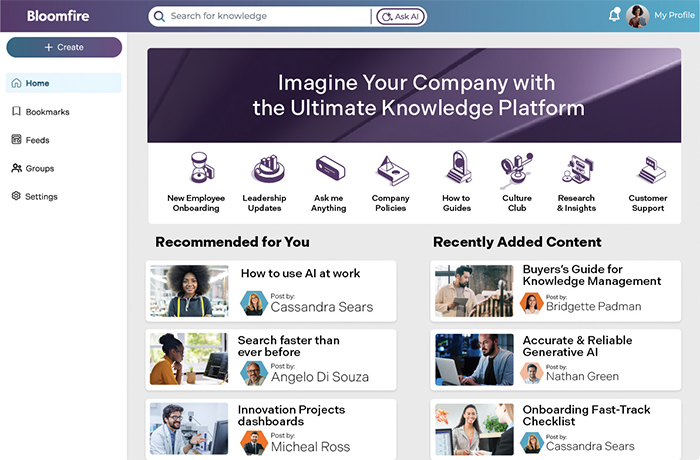
Bloomfire’s Ask AI tool allows employees to easily access and leverage their organization’s collective knowledge. The platform’s natural language processing (NLP) capabilities enable employees to simply ask a question and receive accurate answers with verifiable citations. Search and analysis times have dropped from 30 to 40 minutes in legacy systems to mere minutes using the Ask AI and Author Assist tools. This means users won’t struggle with complex queries or depend on others, as Bloomfire ensures knowledge is at every employee’s fingertips.
The platform also must be secure. Legacy systems can struggle to grant permission-based access or over-rotate on security and create heavily siloed information. Bloomfire safeguards organizations’ critical knowledge by maintaining SOC 2 Type 2 compliance and implementing robust encryption protocols, including end-to-end encryption for data in transit and encryption at rest for stored information. Additionally, permission-based access easily ensures all who need access to data can find it.
“Our goal is to demystify knowledge management, and make the platform synonymous with ease of use and how users create content, search, and collaborate in their daily lives. This familiarity enhances workflow, expedites decision-making and leads to overall productivity gains,” says Benjamin Little, CEO.
From Data Hunters to ‘Data Rockstars’
Empowering every employee to become a ‘data rockstar’ is now within reach. With role-based access to an organization’s collective knowledge base, employees can unlock their full potential to access relevant information and deliver their best performance.
When employees conduct contextual searches in Bloomfire’s Ask AI tool, they can interpret more data and translate it into compelling narratives that highlight key insights and their implications. This makes it easier to understand and act upon to make data-driven decisions and propel a business to new heights.
“We are happy to see how satisfied they are with the platform. When asked how they would rate Bloomfire, we received a perfect 10 out of 10,” says Little. “One of the key administrators of the platform also commented that she’d rather resign than go back to using the old system. That is high praise.”
This transformative power is perfectly illustrated by the success story of a publicly traded Fortune 500 healthcare company that turned their call center agents into rockstars for effective customer service delivery.
The center faced a significant challenge. Patient inquiries— crucial to their service—were hampered by their agents’ inability to access accurate information quickly. This inefficiency jeopardized both agent performance and patient care quality. Bloomfire’s AI knowledge management platform streamlined the process by reducing search time by as much as 80 percent, leading to a remarkable improvement in patient service.
The precision of Bloomfire’s platform ensured correct information was delivered on the first attempt, eliminating the frustration and wasted time associated with multiple searches. The data center’s transition from information hunters to knowledge appliers boosted service delivery and elevated employee satisfaction from 43 percent to an outstanding 100 percent, a notable achievement given the substantial user base.

Our goal is to demystify knowledge management, and make the platform synonymous with ease of use and how users create content, search, and collaborate in their daily lives. This familiarity enhances workflow, expedites decision-making, and leads to overall productivity gains

“We are happy to see how satisfied they are with the platform. When asked how they would rate Bloomfire, we received a perfect 10 out of 10,” says Little. “One of the key administrators of the platform also commented that she’d rather resign than go back to using the old system. That is high praise.”
Tearing Down the Barriers of Seamless Search
One significant modification that sets Bloomfire apart is its ability to centralize all relevant knowledge, effectively eliminating the friction typically associated with information retrieval. Context switching—the need to toggle between multiple platforms to access necessary information—becomes a thing of the past. Whether integrating with Zendesk, Salesforce or other CRMs, Bloomfire ensures knowledge is always active and an omnipresent resource, following users throughout their workday and accessible whenever and wherever it’s needed.
Configuring role-based access for each user ensures sensitive information is available to the right employees while fostering collaboration and knowledge-sharing across the organization. This balance respects organizational hierarchies and enhances teamwork.
The power of integrated knowledge management can be seen in large-scale call center operations.
A particular center was unable to access accurate information scattered across multiple disconnected sources. The center approached Bloomfire with two key objectives—harnessing the potential of GenAI and unifying their fragmented content ecosystem. By implementing Bloomfire’s knowledge management platform, the center curated all the content from multiple sources into a single, easily navigable portal. This resulted in a staggering 88 percent improvement in operational efficiency and an 18 percent reduction in average handle times, as the AI features empowered the agents with prompt, accurate responses without the frustration of information silos.
Evaluating the Impact of Knowledge Management
Robust reporting and analytics capabilities are two major cornerstones of the platform’s value proposition, offering clients unprecedented insights into their knowledge ecosystem. This feature provides a strategic lens through which organizations can view and optimize their information landscape and deliver tangible, quantifiable benefits. Clients can precisely measure its impact on their bottom line, tracking both revenue generation and cost savings attributed to enhanced efficiency. These metrics provide a clear ROI, justifying the investment in knowledge management.
The true power of analytics lies in its ability to illuminate the cognitive pulse of an organization. By analyzing search patterns and user queries, the platform offers a window into the collective mindset of employees. This insight reveals what topics dominate conversations, what information is most sought-after, and crucially, where knowledge gaps exist. Identifying these knowledge gaps—instances of information not contained within the knowledge base—shows organizations where the knowledge base needs expansion or updates. This proactive approach to content management ensures the knowledge repository evolves in lockstep with the organization’s needs.
“Knowledge is power, but knowing what’s missing is the key to improvement. It assures employees have all the knowledge at their disposal,” states Little. “We talk about our ability to help companies identify and eliminate Redundant, Outdated and Trivial information (ROT) in their knowledge base. Data integrity is critical when implementing generative AI in a business, and ROT will undermine even the best knowledge management intentions.”
Masterminds Powering the Success
“When I look at what we’ve achieved, I’m humbled by the realization that none of it would have been possible without the people who make Bloomfire what it is,” says Little.
"Knowledge is power, but knowing what’s missing is the key to improvement. It assures employees have all the knowledge at their disposal"
A team rich in diversity, with each member bringing a unique trait of creativity, empathy, humor or intelligence, weaves the fabric of the company. United by a collective mission to solve the toughest knowledge-sharing challenges, they believe in building a future where the intersection of humans, knowledge and technology drives growth and productivity.
Evidence of this teamwork shines through the successful implementation of Bloomfire’s AI-based knowledge management platform in industry-leading companies.
When Bloomfire is your supercharged digital knowledge management platform, employees can instantly access the accurate data they need and uncover the true narrative of what the data represents, igniting the journey of innovation.
Enterprise Intelligence and the Future of Knowledge Management Software
Organizations generate vast volumes of information across documents, presentations, conversations, ticketing systems and collaboration platforms. Much of this knowledge remains fragmented across repositories, team channels and informal communication threads. Executives responsible for knowledge management platforms face a familiar dilemma: information exists everywhere, yet employees struggle to retrieve reliable answers quickly enough to support real work. Traditional knowledge bases addressed storage and search, though they rarely solved the deeper issue of fragmented institutional knowledge. The emergence of AI-driven knowledge platforms has shifted expectations, placing emphasis on systems that transform scattered information into dependable, context-rich intelligence.
Enterprise leaders increasingly recognize that the quality of underlying information determines the value of AI-generated answers. Many early deployments focused on connecting applications to large language models and expecting useful outputs to emerge automatically. Experience across enterprises now suggests that this assumption overlooks a central requirement: structured, accessible and interpretable knowledge assets. Documents, spreadsheets, presentations and other formats contain valuable institutional context, though extracting meaning from them requires systems capable of interpreting varied data types. Effective knowledge management platforms therefore concentrate less on the model itself and more on preparing the information that feeds it. Careful extraction of meaning from enterprise content allows AI systems to generate responses that reflect the organization’s actual expertise rather than generic approximations.
Trust represents another defining concern for executives evaluating knowledge platforms. AI-generated answers offer speed, yet speed alone cannot justify adoption in environments where employees depend on accurate information for customer support, technical troubleshooting or strategic planning. Systems that behave like opaque black boxes risk undermining user confidence. Leaders increasingly look for platforms that surface the reasoning behind responses and clarify how specific documents or sources influenced the output. Visibility into the information pathways behind answers helps employees evaluate accuracy while strengthening confidence in automated guidance. Enterprises that lack this transparency often discover that employees revert to manual verification, limiting the practical value of AI assistance.
Knowledge accessibility also extends beyond technical design into organizational behavior. Information frequently resides in departmental silos or informal conversations that never reach formal repositories. Employees may attempt a quick search, fail to locate the answer and then request assistance from colleagues through messaging platforms. That pattern consumes time while reinforcing dependency on individual experts. Modern AI-powered search systems reduce that friction by connecting structured knowledge repositories with conversational data sources such as collaboration channels or meeting transcripts. Aggregating these sources creates a more complete view of institutional knowledge and enables employees to resolve questions independently. Greater self-service improves productivity while reducing repetitive internal inquiries.
Bloomfire represents a compelling example of this approach to AI-powered knowledge management software. The platform concentrates on building a trusted knowledge foundation that allows AI systems to generate accurate and explainable answers. Its technology extracts meaning from diverse enterprise content formats and supplies that context to language models so responses reflect real organizational expertise rather than generic data patterns.
Bloomfire also addresses governance and trust through automated knowledge maintenance that identifies redundant or outdated information and improves data reliability without constant manual auditing. Its Synapse interface allows employees to interact with organizational knowledge conversationally while also examining how specific sources contributed to a generated answer. Integration across tools such as Slack, Microsoft Teams and Salesforce expands knowledge access into the environments where employees already work. Organizations pursuing an AI-driven knowledge foundation will find Bloomfire a disciplined and forward-looking choice for turning fragmented information into enterprise intelligence. ...Read more
Company
Bloomfire
Management
Benjamin Little, CEO
Description
Bloomfire combines its knowledge management platform with the proliferation of GenAI techniques, which gives employees the superpower to insert questions in large language models (LLM) and amplify the accessibility of insights that historically would have required assistance from fellow peers. Its AI-powered tools act as digital megaphones for employees, enhancing visibility and making it easy to find and use the needed information without tedious searching.